
Leif Rydell
Southern Australia + Tasmania
Southern Australia + Tasmania.
Since I have been to Australia several times before but not to the southern part, this was a trip high up on my wishing list. My friend Nick from UK and I usually make one trip per year birding and this time we decided to go there. He has been there back 9in time but not for birding. I planned the itinerary to start and end in Adelaide. We started by visiting Kangaroo Island which is a stunning place in many ways. After that we had arranged with local birder Roly from Adelaide to do an Outback tour on the iconic Birdsville track. However, heavy rain earlier in the season made the whole trip impossible and we could only go as far as Etadunna. This meant several of the best birds were not possible. Still a very memorable trip. After this we then started our 10 day round tour from Adelaide in land vis Mildura, Hattah K N.P., Deniliquin, Melbourne and back to Adelaide on the Great Ocean Highway. Our last 5 days we flew in to Tasmania and stayed 4 nights on Bruny Island where you can see all the endemics.
The first pictures here show one of my target birds, the Hooded Plover which I missed in SW Australia many years ago and now spotted on the beach right at the harbour where the ferry arrives as a flock of Lesser Crested Terns. Shorebirds are just my favorite group, so diverse in habitat and appearance. Kangaroo Island is a place a have been reading about for along time and now had the privilege to visit. Many great birds and vistas.

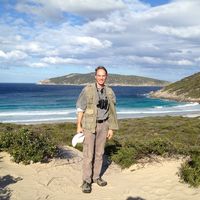
We drove further west on the island and spotted a special Goose, the Cape-barren Goose which breeds in smaller colonies with a few pairs as well as many stunning beaches (Nick by our car).


As the name of the island recalls, there are quite a few kangaroos and wallabies here. This cute Tammar wallaby showed well with a curious look half hidden ehind the bush and a few Silvereyes there as well. One of the most stunning birds and also very common is the Superb Fairy-wren.


Our last stop was at a seal rockery where saw both Au. Sea Lions and A. Fur Seals (and the common Silver Gull). By the center also a flock of Purple-crowned Lorikeets and a few Brown Thornbills.
We had to reschedule as a smaller storm was advertised and there was a risk of canceled ferries. Still, we got much more time around Monarto which showed to be a good choice. In this dry and nowadays threatened type of dry forest we picked up many good birds as this Diamond Firetail and a funny looking Owlet Nightjar.
As well as Brown Treecreeper and Golden Whistler.
Next day was the start of one of the true high lights of the whole trip, driving up to and into the iconic Birdsville track in the true outback. I had been in contact several months before with a local birdingpal from Adelaide, Roly. He had been so kind to take us up there for no guiding fee. just paying for petrol and his food and accommodation. Because of previous rain in Queensland, flooding had cut off the last (and in some way best) birding spots. So leaving we already knew we would miss some good desert birds. However, still a great experience and some excellent top birds as this Australian Pratincole!!
On the way up before entering true outback we saw Brown Songlark and White-winged Fairy-wrens (male not close enough for photo) and Common Bronzewing.
So arid in in some way "boring" nature, it is still so fascinating to see these plains for so many kilometers where I had to take a photo of myself. Also the small villages with classic road houses. Here, Marree Road Hotel at first light. Just lovely!!


In vain, we searched for my super target bird (Inland Dotterel) but the story doesn't end here!! In numbers, not so many birds but we counted ....and among them, next to a water hole, Black-fronted Dotterel, Australian Crake and Black-faced Wood-swallow.


The lord of the outback, the big Red Kangaroos were seen with a few.
To my great joy also decent views of a Dingo, which I hadn't seen before:) and also close by, a large flock of Zebra Finches.
Because of a flat tire and rough road conditions we decided to go back towards Adelaide. That meant Nick and I had 2 days in Adelaide before we could continue our next part of the trip (Our car was pre-booked at this date). We spent the days exploring both the city and some local parks. In the botanical garden we had good views of Easten Rosella, Crested Pigeon and Noisy Miner, all common birds here.
We now stared our inland drive towards our first destination, Mildura. On our way we made a few stops. Didn't see much but close to Mildura we took a detour to an area where some raptors had been reported recently. What then happen is one of the most surprising "the most" (happy) experiences I ever have had when it comes to birding. Alongside the road we saw a lonely guy with binoculars. We stopped and asked if he had seen something special. Wee he said, there have been a few sightings of some inland birds but he hadn't seen all, just and Inland Dotterel. What!! An INLAND DOTTEREL?. Yes there's one with chicks on the other side of the road. I had been so dissapointed not seeing it on our inland tour and now it was here on a total unexpected place. Nothing but a miracle! My number one wishing bird!
Mildura is just north of the famous Hattah Kulkyne NP. This is a dry forest area with section of grassy bushes. Among many other birds it's home to the threatened Mallee Emu-wren and also the Striated Grass-wren. The Striated was high up on my list as I had never seen one and we also missed our chance in the outback because of the flooded part. We spent a day and a half here and didn't see so much actually. On the second day we ha much better birding. At the target spot we finally saw 3 Striated Grass-wrens. Magic and funny bird just running quickly in the bushes making photos a hard thing.
Much easier not far from here were the 2 following birds as there was a small waterhole which attracted some honeyeaters as Yellow-plumed and Sipny-cheeked Honeyeater.
We also made a detour here as I had heard this section could be the place to be lucky enough to see the Malleefowl. Sometimes birding can feel disapointing and some times not. One bird was just crossing the road which gave us excellent views. Just a few hundred meters from here we also had a day roosting Tawny Frogmouth.
Our journey continued towards Deniliquin which is a nice town with a classical touch just by the river. Our target here was the Superb Parrot which has its most south westerly range here. We serached in many places without seeing it but had some good views of these Red-rumped Parrots.
Next funny and lucky episode occurred when we made a last try a smaller road for the Superb Parrot. We saw nothing and we decide to turn back and go to the next town. As I need a quick pi before reaching the main road again we stopped just randomly. Going back to the car Nick told me there were some parrots in the tress on the other side of the road and there they were. A flock of 7 birdf!!! Here an adult half hidden and a well seen juvenile. A little bit further away we had this great sighting a a family Eastern Grey kangaroos in the middle of a field.
On the the way south towards Melbourne we had a big flock of Long-billed Corellas and a lonely Eastern Grey Kangaroo in a swamp.
We arrived to melbourne in the afternoon and just went in to a restaurant. We had 2 nights here and this airbnb was not good (but cheap). We had to call the owner as the sheets were dirty. Reason for choosing this place was the convenience to the famous Western Water Treatment Plant which is a mecka for birds. You need a key though and we were lucky to get in contact with Stewart Mockton, a very nice and pleasant guy to spend a day of birding with. Some of the birds immediately seen here were Yellow-billed and Royal Spoonbill, Brown Falcon and Welcome Swallow.
The area is full of pools and you navigate on smaller and narrow roads between these. Two birds very high up on my list were Latham's Snipe and Red-kneed Dotterel. The latter I saw in bad light and quite a distance up in the Northern Territory a few years back so it was a very pleasant sight today. There were also a lot of Sharp-tailed Sandpipers which is the most common (migrating) wader in Australia. I never saw the Snipe but was lucky a few days later by the coast.
Among these, also plenty of Pied Stilts (now split again), Au. Shelducks (females have white around the eye),Whiskered Terns and a few Fairy Martins.
An afternoon Downtown was also in our agenda as it would have felt stupid not to see some of this great city.

Our trip continued towards the Great Ocean Road which would be the last, but very long trip with a few nigts on the way back to Adelaide. At our first stop we several Sulphur-crested Cockatoos and a handsome Yellow-faced Honeyeater.
The next day we drove a little bit inland to Otway Forest park as a detour. This region is a rainforest patch with chance of some other birds. We had soft rain more or less all day but still we saw some excellent birds as Grey Shrikethrush, Flame Robin, Red-browed Finches and a female satin Bowerbird.
Further up the road we had close views of a Koala with baby and at a local café a group of stunning King Parrots and Crimson Rosella.

Next stop was the famous 12 Apostles which certainly is a fantastic sighting, not much for birding though.

As we drove further east we passed some forested areas were we saw a few flocks of the majestic Yellow-tailed Black Cockatoos and many New Holland Honeyeaters. Reaching drier areas we saw a few Echidnas and many Stud-tailed Lizards, known as "Stubbies".
Our last night before coming back to Adelaide was the region around Goolwa. A good spot for Rock Parrots but this species we searched for in vain. A little bit north of Goolwa is an other water treatment area and we we lucky to see a few Banded Stilts among all the Pied. Here also some White-fronted Chats and Singing Honeyeaters.


At a local beach we also had a big flock of another stunner, the tiny Red-capped Plover and by a lake close by a few Black Swans.
I felt I had been away for quite a while but we still had 5 days in Tasmania, mainly at Bruny Island which holds more or less all endemics. After a night at an airport hotel we flew off. We reached our accommodation at Adventure Bay which is famous to be one of the first places the explorers landed on. In general the beaches at Bruny are exceptional in beauty with rain forest like trees bordering them.


The weather was not pleasant during our stay, heavy rain or when the sun shone, strong winds. This means challenging birding. Still we saw all the day active endemics except the Forty-spotted Pardalote. At our cottage we had many endemic birds including Tasmanian Native Hen, Yellow-throated Honeyeater, Green Rosella and to my big surprise the quite hard Strong-billed Honeyeater.
Bruny Island is relatively small and you can visit many places during a day. Looking not only for endemics we drove to the most northern part where we saw Sooty and Au. Pied Oystercatcher by the beach and close by a pair of Kelp Gulls and Chestnut Teal.
Some parts of Bruny is rainforest and at one spot there is a trail which usually holds the stunning Rosy Robin and the more modest Tasmanian Thornbill.
As a final part of this fantastic trip pictures of the endemic Bennet's Wallaby, Beautiful Firetail, White-bellied Sea-eagle, the ever present Superb Fairy-wren and the iconic Laughing Kokaburra. Great trip and country, go if you can!!

In total we saw 231 species of which 46 were lifer (bold)
List of birds: Au. Gannet, Au. pelican, Great Cormorant, Little Black Cormorant, Little Pied Cormorant, Pied Cormorant, Black-faced Cormorant, Silver Gull, Pacific Gull, Kelp Gull, Caspian Tern, Au. Gull-billed Tern, Crested Tern, Whiskered Tern, Fairy Tern, Sooty Oystercatcher, Au. Pied Oystercatcher, Pied Stilt, Banded Stilt, Red-necked Avocet, Pacific Golden Plover, Au. Pratincole, Red-capped Plover, Inland Dotterel, Black-fronted Dotterel, Hooded Plover, Red-kneed Dotterel, Banded Lapwing, Masked Lapwing, Latham's Snipe, Bar-tailed Godwit, Common Greenshank, Red-necked Stint, Sanderling, Curlew Sandpiper, Sharp-tailed Sandpiper, Black Swan, Cape Barren Goose, Musk Duck, Blue-billed Duck, Maned Duck, Au. Shelduck, Pink-eared Duck, Au. Shoveler, Chestnut Teal, Grey Teal, Hardhead, Pacific Black Duck, Gr. Crested Grebe, Hoary-headed Grebe, Au. Grebe, White-faced Heron, White-necked Heron, Great Egret, Royal Spoonbill, Yelloe-billed Spoonbill, Au. White Ibis, Straw-necked Ibis, Brolga, Buff-banded rail, Au. Spotted Crake, Eurasian Coot, Dusky Moorhen, Common Moorhen, Black-tailed Native-hen, Tasmanian Native-hen, Emu, Malleefowl, White-bellied Sea-eagle, Little eagle, Wedge-tailed eagle, Whistling Kite, Black Kite, Black-breasted Buzzard, Swamp harrier, Black-shouldered Kite, Nankeen Kestrel, Brown Falcon, Au. Hobby, Tawny Frogmouth, Au. Owlet-nightjar, Glossy Black-Cockatoo, Yellow-tailed Black Cockatoo, Gang-gang Cockatoo, Galah, Long-billed Corella, Sulphur-crested Cockatoo, Rainbow Lorikeet, Musk Lorikeet, Purple-crowned Lorikeet, Swift Parrot, Superb Parrot, Regent Parrot, Green Rosella, Crimson Rosella, Eastern Rosella, Red-rumped Parrot, Blue-winged Parrot, Elegant Parrot, Blue Bonnet, Rock Dove, Spotted Dove, Common Bronzewing, Brush Bronzewing, Crested Pigeon, Peaceful Dove, Pallid Cuckoo, Lauging Kookaburra, Sacred Kingfisher, Red-backed Kingfisher, Rainbow Bee-eater, Welcome Swallow, Fairy Martin, Tree Martin, Scrubtit, White-browed Scrubwren, Tasmanian Scrubwren, Striated Fieldwren, Weebill, Yellow Thornbill, Tasmanian Thornbill, Brown Thornbill, Chestnut-rumped Thornbill, Yellow-rumped Thornbill, Spotted Pardalote, Red-browed pardalote, Striated Pardalote, Superb Fairywren, Splendid Fairywren, White-winged Fairywren, Purple-backed Fairywren, Striated Grasswren, Singing Honeyeater, Yellow-plumed Honeyeater, White-plumed Honeyeater, Purple-gaped Honeyeater, Yellow-tufted Honeyeater, Yellow-throated Honeyeater, Strong-billed Honeyeater, Yellow-faced Honeyeater, Pied Honeyeater, White-fronted Honeyeater, New Holland Honeyeater, Crescent Honeyeater, Tawny-crowned Honeyeater, Eastern Spinebill, Spiny-cheeked Honeyeater, Blue-faced Honeyeater, Noisy Miner, Little Wattlebird, Red Wattlebird, Yellow Wattlebird, Orange Chat, White-fronted Chat, Crimson Chat, Cinnamon Quail-thrush, Chirruping Wedgebill, White-browed babbler, White-throated Treecreeper, Brown Treecreeper, White-winged Triller, Black-faced Cucoo-shrike, Black-faced woodswallow, Dusky Woodswallow, White-breasted woodswallow, Masked Woodswallow, Pied Currawong, Black Currawong, Grey Currawong, Pied Butcherbird, Grey Butcherbird, Au. Magpie, White-winged Chough, Apostlebird, Au. Raven, Forest Raven Little Raven, Little Crow, Satin Bowerbird, Magpie Lark, Grey fantail, Willy wagtail, Jacky Winter, Hooded Robin, Dusky Robin, Eastern Yellow Robin, Pink Robin, Red-capped robin, Flame Robin, Scarlet Robin, Rufous Whistler, Olive Whistler, Golden Whistler, Grey Shrike-thrush, Silvereye, Au. Reed Warbler, Little Grassbird, Rufous Songlark, Brown Songlark, Au. Pipit, Bassian Thrush, Common Starling, Common Myna, Zebra Finch, Red-browed Finch, Diamond Firetail, Beautiful Firetail, House Sparrow, Eu. Goldfinch.
 Add
Add
Previous posts
- Februari 2026
- Januari 2026
- April 2025
- September 2024
- June 2024
- May 2024
- July 2023
- June 2023
- September 2022
- December 2021
- December 2020
- August 2020
- July 2020
- June 2020
- March 2020
- November 2019
- December 2018
- Januari 2018
- December 2017
- Januari 2017
- November 2016
- October 2016
- September 2016
- August 2016